21 Jul
computer mouse

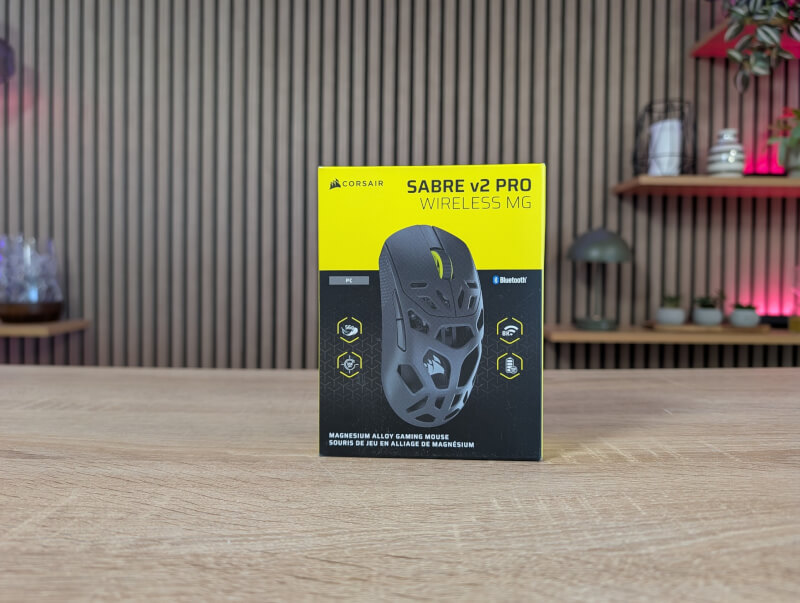
Looking at the hardware itself, there is no difference between this version and the "normal" Sabre v2 Pro other than it is made with magnesium instead of plastic.
The Sabre v2 Pro Wireless MG is a wireless, symmetrical gaming mouse, and the shell itself is made of magnesium with geometric cutouts to keep the weight down. The weight comes in at 56 grams. Funnily enough, this makes it 20 grams heavier than the original plastic version, but just a single gram heavier than the carbon fiber (CF) model.
The choice of material means that we get a mouse that feels significantly more robust than a plastic mouse. At the same time, the slightly cool metal surface also feels just nice to use.
The design has a low back that primarily caters to claw or fingertip grips. The magnesium shell has a matte black finish with a slight metallic sheen, and it does an impressively good job of repelling greasy fingers.
The holes in the shell are barely noticeable in practice, and although the cutouts may look a bit random, they ensure a robust structure that in no way feels flimsy.
The heart of the mouse is Corsair's own Marksman S optical sensor. The specifications are 33,000 DPI, 750 IPS and an acceleration of 50G.
You get a total of five programmable buttons. The primary buttons are large and flat, while the side buttons are well-placed and easy to distinguish in the heat of battle.
At the bottom we find two curved UPE skates, a dedicated DPI button and a switch to choose between 2.4 GHz wireless and Bluetooth.
Corsair has also included extra (and larger) glide pads, grip tape, and a braided USB-C cable in the box.
One of the most liberating new features of this mouse is the configuration. Corsair has made it possible to avoid their otherwise rather heavy iCUE software. The mouse can instead be controlled via the Corsair Web Hub, a lightweight, browser-based tool. This means you can configure the mouse from any Chromium browser, no matter what computer you're sitting at.
Here you can quickly remap the five buttons, record macros, and disable unnecessary DPI steps. It's also where you adjust advanced sensor settings.
You can change the polling rate (up to 8000 Hz), adjust the lift-off distance, and turn features like Motion Sync, Angle Snapping, and Ripple Control on or off. It's simple, fast, and incredibly effective.
I've had the Corsair Sabre v2 Pro Wireless MG on my desk for about a week. I've used it both as my primary mouse for desktop use and work, but also for gaming.
In practice, it's a completely flawless experience. In fast-paced, demanding shooters like Call of Duty and Overwatch, tracking is lightning-fast and incredibly accurate.
The big selling point, besides the special material, is the ability to run at an 8000 Hz polling rate. This theoretically eliminates any form of lag, but few people will notice a significant difference in their gameplay compared to 1000 Hz unless you're playing at an absolute elite level with an absurdly fast screen.
As a mere mortal gamer, I haven't been able to notice any difference in my gameplay during testing, so personally I don't think the big reduction in battery life is worth it.
Underneath the main buttons are Corsair's own mechanical switches, rated to withstand 100 million clicks. They have a very crisp, tactile feedback and are thankfully on the quiet side. The scroll wheel is a bit soft, and the middle click itself lacks a bit of resistance, but these are minor things in the big picture.
At the time of writing, I can find the Corsair Sabre v2 Pro Wireless MG for $149.99. That's about $70 more than the regular Corsair Sabre v2 Pro. So it's not a cheap mouse, but it's far from the most expensive we've tested. Considering that Corsair is experimenting with new materials and its design stands out, it might not be entirely off the mark.
The Corsair Sabre v2 Pro Wireless MG is a “professional” gaming mouse in the truest sense of the word. It takes a familiar formula of low weight, solid sensor, and effortless glide, and adds the build quality of magnesium alloy. The result is a lightweight mouse that actually feels like a piece of sturdy, expensive tool rather than plastic.
When you add Bluetooth support, the brilliant browser-based software and all the included accessories on top of that, you get an incredibly complete package.
The style of the mouse is a matter of taste that will divide the waters, but personally I think it's a beautiful mouse.
The price is of course higher than for the standard version, and you should be aware that 8000 Hz polling eats up the battery incredibly quickly (you get about 21 hours versus 120 hours at 1000 Hz).
But if you're looking for a strong and stable wireless mouse that has some of the latest technical advantages and a nice build quality, the magnesium-clad Sabre v2 Pro is an excellent choice.
We end up with a final score of 8, for a mouse that doesn't stand out much from the market of high-end gaming mice in terms of technical details, but which wins in terms of materials and style.
Benefits
Disadvantages