Bambu Lab launches P3C with tool-changing

P3C-001
Translate from : Bambu Lab lancerer P3C med tool-changing
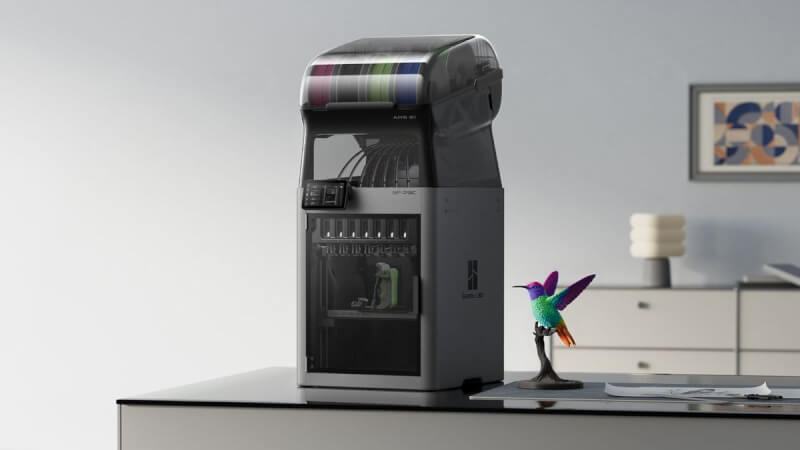
Bambu Lab has officially launched the Bambu Lab P3C, a new desktop 3D printer focused on multi-material printing. The printer is designed to deliver the highest value in the tool-changing 3D printer market by bringing the company’s advanced third-generation Swaptek™ architecture into an affordable desktop form factor.

The Bambu Lab P3C is equipped with a 7-slot Swaptek™ tool change system, with 5 standard PrintTools pre-installed from the factory, while 2 free slots give the user the freedom to add additional tools as needed. The system is combined with an integrated AMS 3P unit and a FlexFeed extruder that supports both 1.75mm and 2.85mm filament with lightning-fast material changes in just 6 seconds. The entire purpose of the launch is based on Bambu Lab’s belief that new technology only truly changes reality when enough creators have access to it.

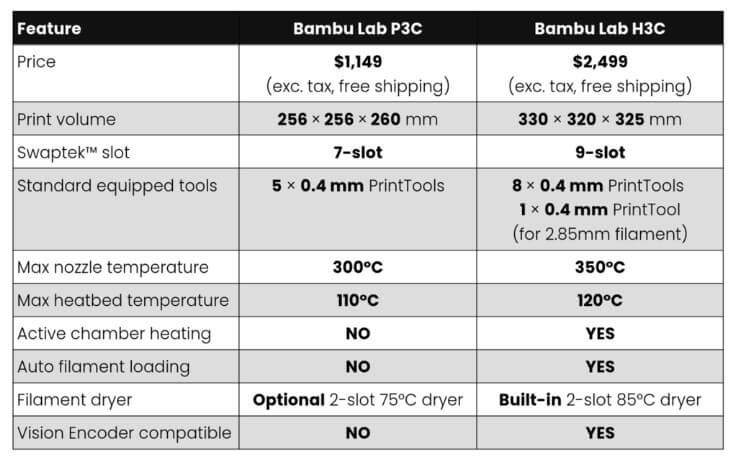
READ ALSO: Bambu Lab H3C Review.

Multi-material printing in practice: One overall print job

By packaging professional tool-changing technology into an accessible device, P3C makes it possible to combine widely varying colors, hardnesses and nozzle sizes in a single file – tasks that previously required multiple machines, manual tool changes and large amounts of waste plastic:
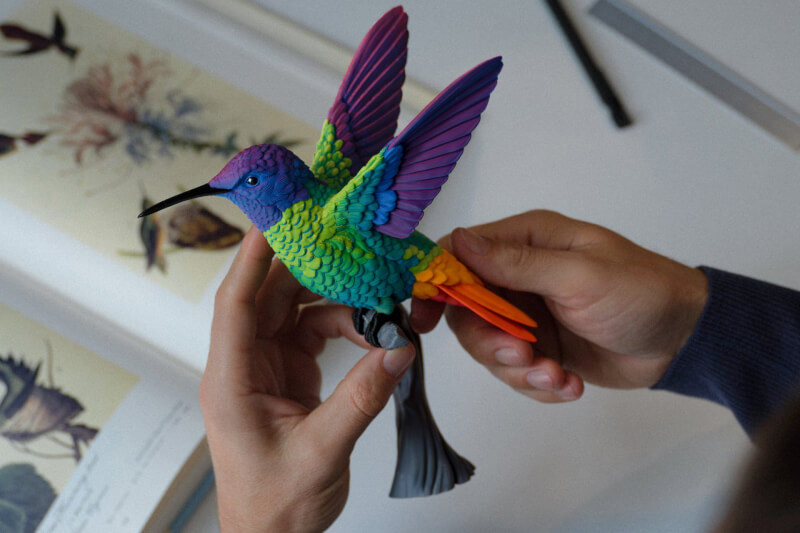
  • Precision across scales: For example, the user can print a complete wristwatch in one pass. The delicate dial is printed with an extremely fine 0.2 mm nozzle, the hard case itself is created with a 0.4 mm nozzle, while the soft TPU strap is printed with a separate 0.4 mm nozzle fed with strong 2.85 mm filament.
  • Less assembly: Complex objects like a moving robot can be printed in one piece (print-in-place), with all parts having the exact color and material type from the start. The flexible TPU 75A joints allow the figure to be lifted directly off the build plate as a fully movable unit without the need for gluing or painting.
  • Advanced wearables: Until now, flexible filament printing has typically been limited to one material in one color at a time. P3C lets users combine TPU with different Shore hardnesses in the same part – for example, a shoe in multiple colors that is soft and flexible where the foot needs to bend, and firm where support is needed.
  • AI-generated models in real life: Detailed and multi-colored 3D models created via AI have often had to stay on the screen due to time-consuming color changes and waste. With P3C, they are translated directly into physical objects without extensive planning.

F.jpg

Inside Swaptek™: Intelligent active control and preheating

Where traditional tool changers often use passive mechanics, Swaptek™ relies on active electronic control of the entire process. Each PrintTool has its own filament path and heating system, with the material remaining loaded in its dedicated tool, never having to be retracted until the next change.

Because each tool has its own power and data connection, the printer pre-reads the print file and begins preheating the nozzle of the next tool while the current tool is still working. A dedicated contact sensor ensures direct and accurate temperature measurement (unlike infrared sensors that are sensitive to dirt), meaning the new material hits the model in just 6 seconds with minimal waste (purging).

The FlexFeed extruder itself is powered by a dedicated PMSM motor that electronically regulates the clamping force on the filament to prevent uneven extrusion. At the same time, the tool stand uses a retractable Z-axis mechanism (retractable rack) that ensures tight tolerances when connecting and pulls the filament hoses away from the build chamber during the print itself. This eliminates vibrations, improves surface quality and provides a clear view of the part through the windshield.
P3C-008-1.jpeg

Capacity up to 22 colors and integrated moisture protection

The five included PrintTools come with 0.4mm nozzles for 1.75mm filament, while the two additional slots can be equipped with special tools for 2.85mm flexible filament or simply expand the color capacity. All nozzles are made of fully hardened steel (HRC 55+), making the printer ready for abrasive materials such as carbon fiber and fiberglass reinforced filament. In addition, 0.2mm, 0.6mm and 0.8mm nozzles are offered as accessories.

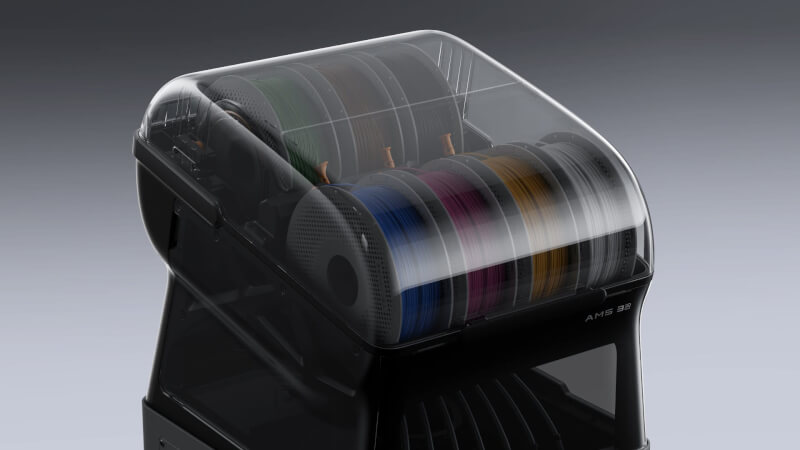
If you need even more colors than the 7 built-in slots, an optional buffer can be connected to PrintTool No. 1, which allows you to connect up to 4 external AMS units and achieve printing in up to 22 colors. In the integrated AMS 3P, the spools are stored in closed chambers protected from humidity, and the user can purchase a drying module of up to 75°C, which dries two spools simultaneously during printing.
P3C-005.jpeg

Created for hobbyists, families, design studios and print farms alike

Bambu Lab has targeted P3C towards four primary user groups:
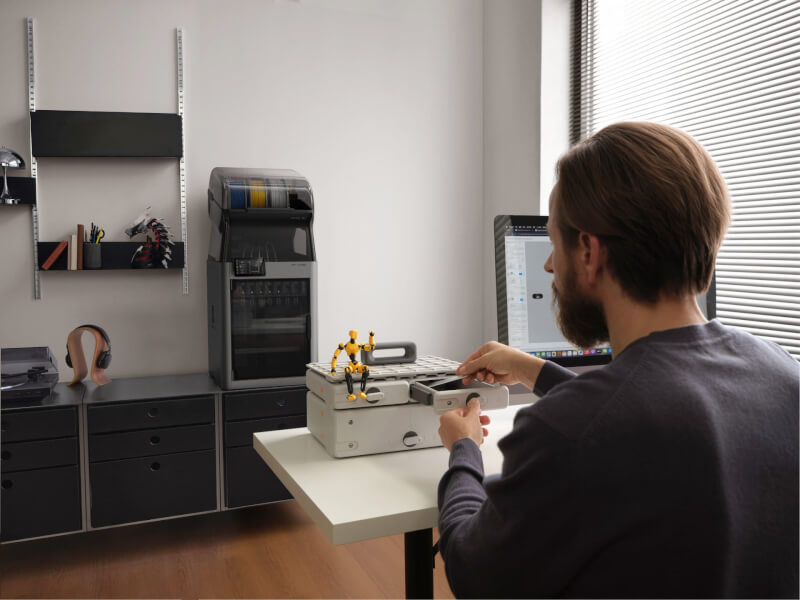
  • Hobbyist Maker: Avoid hours of calibration and buckets of waste plastic by simply selecting materials in Bambu Studio and sending one file.
  • Family Creator: Can print toys with a solid body and soft rubber wheels in one complete print without manual assembly afterwards.
  • Small Studio: Can produce finished multi-color and multi-material prototypes in one run – with integration of CraftTools for carving and embossing in the same workflow.
  • Print Farm Starter: Avoids manual tool changes, constant monitoring and expensive filament waste thanks to automatic 6-second changes and batch production.

A.jpg

Technical specifications for Bambu Lab P3C

  • Construction volume: 256 × 256 × 260 mm
  • Maximum nozzle temperature: 300 °C (hardened steel nozzle and extruder gear)
  • Maximum build plate temperature: 110 °C
  • Supported nozzle diameters: 0.2mm, 0.4mm, 0.6mm and 0.8mm
  • Supported filament diameter: 1.75 mm and 2.85 mm (via bypass feed only)
  • Air purification: Built-in HEPA filter (Grade H11)
  • Supported materials: PLA, PETG, PCTG, TPU, EVA, PE, PP, PHA, PVA, BVOH, support filament, ABS, ASA, HIPS, PA, PAHT, PC, PET, PPA and carbon fiber and glass fiber reinforced versions thereof.
  • Physical dimensions and weight: 413 × 538 × 540 mm / 26.5 kg (including AMS 3P)

Bambu Lab H3C vs H3P.jpg


Our Partners