25 Sep
gadgets

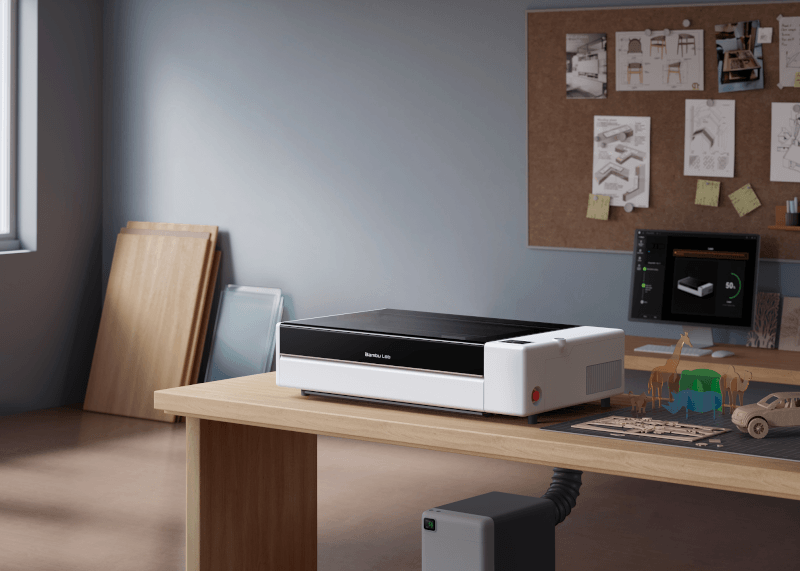
With R1, Bambu Lab expands its personal manufacturing ecosystem, allowing creators and small businesses to combine 3D printed components with laser-cut materials on the same workbench and under the same software platform.
At the heart of the R1 is a powerful 55W CO₂ laser tube . Unlike diode lasers, where the light beam passes directly through transparent materials, the CO₂ wavelength in the R1 can cut and engrave in both clear acrylic and glass .
The laser cuts materials such as wood, acrylic, leather, paper and textiles, and can also engrave on surfaces such as glass, stone and coated metal. The R1 is capable of cutting significantly thicker wood and acrylic sheets at faster speeds and with less soda deposits along the cutting edges compared to diode lasers – including up to 18 mm black walnut plywood and up to 20 mm acrylic .
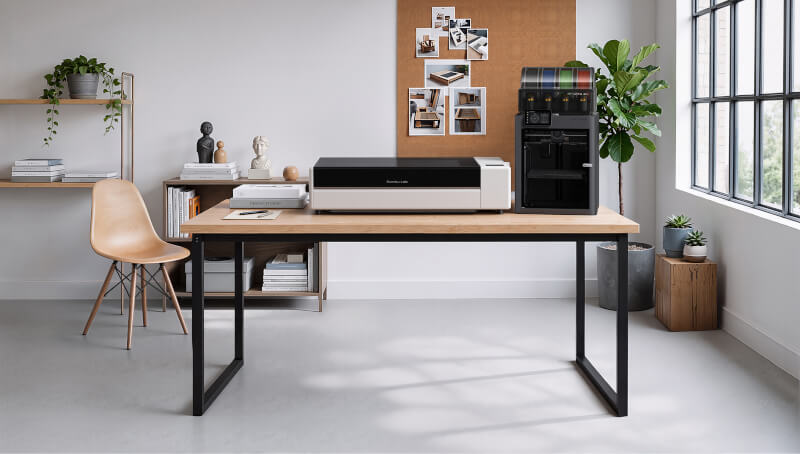
The machine has a standard working area of 600 × 300 mm . However, using the optional Conveyor accessory, the R1 can feed sheet materials in lengths of up to 3,000 mm through a feed-through opening, making furniture-sized work possible. The system is also capable of engraving on curved objects such as bowls.
The biggest technical challenge with traditional CO₂ laser cutters has historically been the manual adjustment of the mirrors that guide the laser beam from the tube to the cutting head. If the mirrors move even fractions of a millimeter, the laser loses precision and cutting power. The process has previously required the user to manually set up heat-sensitive paper, fire test shots, read the burn mark, and adjust the mirror screws by hand – a task that could take over an hour for beginners.
Bambu Lab solves this with the Auto Laser Alignment feature. By mounting a Laser Alignment Sensor (a plate with crosshairs) on the cutting head, the machine automatically detects where the beam hits using motorized actuators on the mirrors and automatically corrects the light path. The entire calibration is completed without paper or manual adjustment screws in about one minute.
Before cutting begins, the R1 automatically calculates location, surface height and path of motion via its built-in TriSense System , which combines cameras, lasers and encoders:
Positioning: A BirdsEye Camera captures the entire work area, a Toolhead Camera is positioned directly over the cutting area, and a Pinpoint Laser marks the exact point on the material. This allows you to track printed contours – such as stickers – and cut them with a precision of less than 0.2 mm.
Measurement: A Distance Measurement Laser reads the surface height and automatically adjusts focus on both flat and curved surfaces.
Tracking: XY encoders report the tool head position in real time to keep all movements precisely on course.
The motion control itself reuses the algorithms that Bambu Lab has developed for its 3D printers, but adapted to laser operation. The system uses Vibration Compensation , which counteracts mechanical resonances and prevents jagged edges during sharp turns. At the same time , Speed-Synced Laser Power is used, where the laser power is automatically regulated in line with the head speed (up to 1,000 mm/s), so that burn marks and tone values are kept completely uniform in both corners and on straight lines. A Vision Encoder calibration board is offered as an accessory, which keeps the absolute motion precision within 0.1 mm over 600 mm of travel.
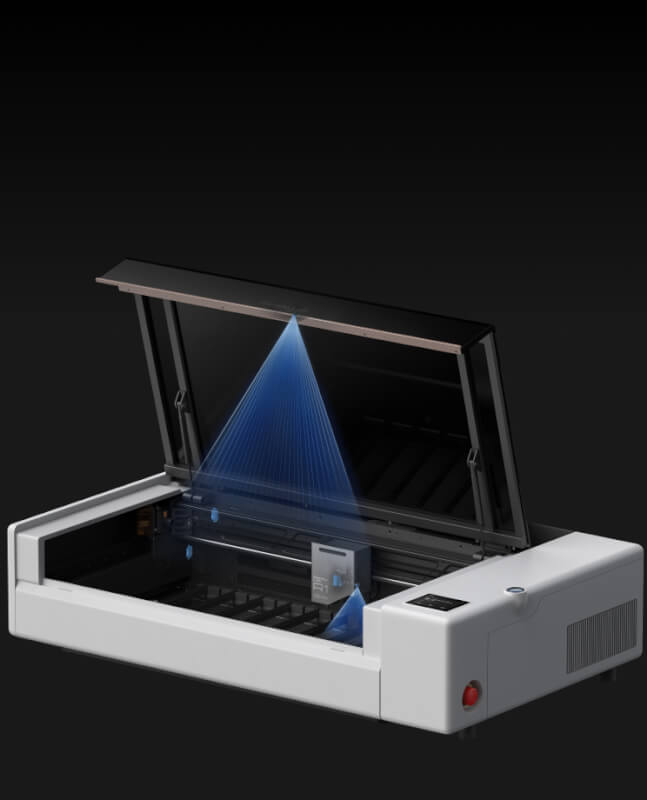
The Bambu Lab R1 is safety certified as a Class 1 Laser product according to the IEC 60825-1 standard, which is the safest classification for consumer electronics. During normal closed operation, the laser beam is completely contained, allowing the machine to be operated without protective eyewear or a separate shielded room.
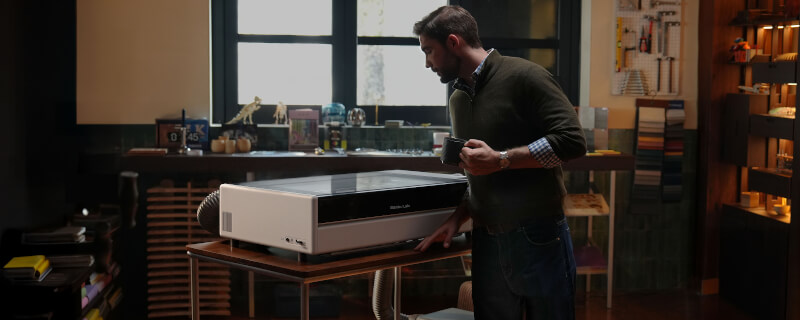
Ventilation: A Crossflow Ventilation system uses an additional fan on the right side to blow air across the cabinet and draw out the fumes. When long boards are passed through the feedthrough opening, the airflow creates an invisible air curtain that keeps fumes inside the chamber until they are extracted.
Built-in protection systems: Opening the door during operation stops the laser immediately, a sensor continuously monitors for flames, and an emergency stop button can cut off all power. An automatic fire extinguishing system ( Auto Fire Extinguishing System ) and the E1 Pro Air Purifier with activated carbon exhaust filter are available as optional equipment.
Compact footprint: Compared to representative CO₂ lasers with a similar working area, the R1 takes up approximately one-third less space on the table.
The R1 runs directly on the well-known Bambu Suite software platform (for Windows and macOS) and uses the same MakerWorld platform and Bambu account as the manufacturer's 3D printers. Existing Bambu Lab users therefore do not have to learn a new software system, but can control both 3D printing and laser cutting in the same environment.