25 Sep
gadgets

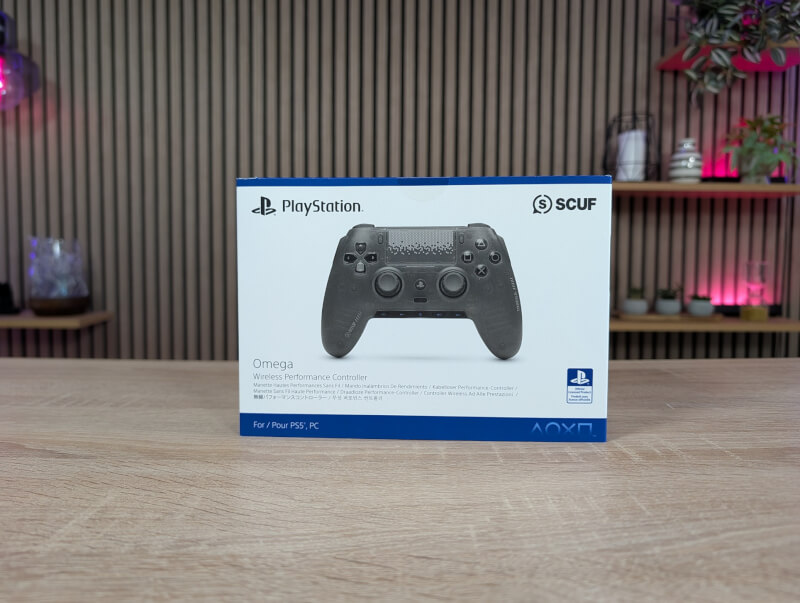
First impressions of the SCUF Omega are reminiscent of previous controllers from SCUF, such as their SCUF Envision. The controller is distinctive, muscular and built to an extremely high quality. It is based on the familiar PlayStation form factor with a symmetrical stick layout, but the housing itself is made a little slimmer than the normal DualSense, which makes it easier to grip. Together with a number of new “non-slip” textures, it ensures that the controller lies effortlessly in the hands, even when they start to sweat during hours-long sessions.
The box comes with a practical case for storing and transporting the controller. It's very nice to have, but I wish it had been made with storage for the extra parts that also come with it.
The SCUF Omega is available in several different designs, but we have a fairly limited selection in Denmark. We have been visited by the “Smoke” version, which has a partially transparent, gray design. Other versions that should be available in Denmark are black, white, Light Gray and Steel Gray.
Elsewhere in the world, there are 16 other designs available, primarily made with a focus on Call of Duty esports teams. This also clearly shows the target audience that SCUF Omega is specifically targeting.
The design's greatest genius is its modularity. The entire top plate is attached with magnets, and when you lift it off, you get access to swap out almost everything, without the need for tools. You can swap out the analog sticks, slide rings, D-pad, action buttons, and touchpad.
Although there are 18 interchangeable parts, unfortunately you only get three sets of thumbsticks (concave, convex and long versions of both), while alternative action buttons and D-pads have to be purchased separately. However, there are currently no additional accessories for sale for the SCUF Omega. In addition to the extra buttons and sticks, two sets of covers are also included so you can cover the R1 and R2 buttons on the back and the two side buttons. So if you don't want to use them, they can easily be covered so you don't accidentally press them.
At the bottom, the controller features an RGB light strip, which remains static on PS5 and can only be color-customized on PC.
On the back we find four paddles that are designed to sit where your middle and ring fingers naturally rest, so you don't have to change your grip along the way.
On top of that, we get two additional buttons on the sides of the controller. At the bottom of the controller under your thumbsticks are five more buttons. On PS5, three of them are locked to control volume, while the two outermost ones are customizable. On PC, however, all five buttons can be customized as you like. All of the buttons can be customized via software, which I'll look at later in the review.
But the most controversial design choice is the absence of vibration motors. SCUF has completely removed everything called rumble, haptic feedback and adaptive triggers. This is done to reduce the weight to a comfortable 254 grams, but most importantly: to eliminate any kind of internal vibrations that can interfere with your fine motor movements. So it's clear that the SCUF Omega is probably aimed mostly at FPS players.
The software part of the SCUF Omega is handled entirely via SCUF's dedicated mobile app for iOS and Android, giving you access to a wealth of deep configuration options:
The most exciting feature in the app, however, is the ability to set a true 0% deadzone. This means that the analog sticks respond to even the most microscopic movements, which is a massive advantage when aiming with a sniper rifle. This is where the Omega has a noticeable advantage over competitors like the Raikiri II and DualSense Edge.
The app supports real-time adjustments, but it has one notable flaw: It's only available for smartphones. If you're gaming on your PC, it's annoying to have to fish out your phone to adjust your controller, rather than just opening an app on your PC. Here, I'd have liked to see integration with Corsair's new web app.
Another software hub is the use of the five “G-Keys” at the bottom of the controller. If you’re playing on PC, they can be freely reprogrammed to do anything. But if you’re playing on PlayStation 5, G2, G3, and G4 are locked to hardware functions like mute, volume, and microphone adjustment, leaving you with only G1 and G5 as free buttons.
When Omega hits the virtual battlefield, it quickly proves its worth. Out of the total of 28 inputs, 11 of them (the 4 paddles on the back, 2 side buttons and the 5 G-Keys) are defined as additional inputs that can be customized.
The two triggers (L2/R2) are a chapter in themselves. Via a physical slider you can adjust the travel, from full movement for racing games to an ultra-short “mouse click” for shooters. SCUF has equipped them with mechanical Omron microswitches, which provides an incredibly direct, crisp and defined feedback that is most reminiscent of a high-end gaming mouse.
The two thumbsticks use the most modern hardware on the market: “Endurance TMR” technology with magnetic sensors. There are no physical potentiometers to wear out, which structurally eliminates the problem of stick drift forever.
On the PC front, where I've primarily tested, the Omega delivers a fast 1,000 Hz polling rate, and impressively this applies both wired via USB-C and wirelessly via the included 2.4 GHz USB-A dongle. The PS5 also uses a native 2.4 GHz connection, while Bluetooth is reserved for mobile devices (iOS and Android). While the 1,000 Hz polling rate provides a measurable advantage on PC, the effect on the PlayStation 5 is limited by the console's own architecture.
I've been testing the SCUF Omega over a few days and during that time have primarily played the new Diablo IV expansion, Vessel of Hatred, but have also supplemented it with Star Wars Jedi: Fallen Order and, in the spirit of the controller, a bit of Call of Duty.
While I certainly don't feel at home in FPS games like Call of Duty with a controller, all three games were a pleasure to play with the SCUF Omega. The many customization options for the extra buttons are a nice boost, and the freedom is even greater on PC, where you are not limited to using controller functions, but can freely choose PC functions, shortcuts and macro settings for all buttons.
As a nice bonus, the touch field at the top of the controller also works fine as a mouse in Windows for quick navigation.
Battery life is rated at 17 hours, and in our tests it never ran out during long sessions. That's solid and better than the DualSense Edge, though it pales in comparison to the ASUS ROG Raikiri II, which can go up to 50 hours. The battery charges quickly via USB-C, and the status LED keeps you well informed.
At the time of writing, I can find the SCUF Omega with an online price of just under 1,800 kroner. That makes it the most expensive controller we've tested, and it beats out a very comparable offering like the ROG Raikiri II, which is targeted at Xbox.
The SCUF Omega isn't a jack-of-all-trades controller; it's a clinical, high-performance, specialized tool. With 28 inputs, interchangeable TMR sticks, Omron mechanical switches, and the ability to set true 0% deadzones, it packs 15 years of esports experience into one device.
The obvious "weaknesses" - no rumble, no haptic feedback and no adaptive triggers - are all deliberate design decisions made to maximise your in-game performance. The fact that the G-keys are locked on PS5 and the app only works on mobile detracts from the overall experience a bit.
But the bottom line is clear: the SCUF Omega is the absolute strongest and most dedicated competitive controller for PlayStation 5 and PC that money can buy right now.
The price of just under $220 is steep, and if you want to play God of War or Spider-Man with full immersion and shaking hands, you should look towards the DualSense Edge instead and can save about $20 at the same time.
But if you live to climb the leaderboards in multiplayer shooters, the SCUF Omega is your new best friend. The SCUF Omega is aimed squarely at FPS fans.
We end up with a final grade of 9 and an Enthusiast Only Award for a super cool and complete PS5/PC controller, which, however, gives up certain features to fully tune into the FPS market.
Advantages:
Disadvantages :